I thought it was about time I did a summer update.
I now have a presence on facebook, as well as a Gardening for Wildlife Group and a Gardening for Wildlife Cause, trying to raise awareness of the importance of wildlife gardens. I have also created a Gift Application, so you can send wildlife images to your friends! So if you are a user of Facebook, please check us out.
I now have a presence on facebook, as well as a Gardening for Wildlife Group and a Gardening for Wildlife Cause, trying to raise awareness of the importance of wildlife gardens. I have also created a Gift Application, so you can send wildlife images to your friends! So if you are a user of Facebook, please check us out.

It has been very wet so the ground is squelchy and the burn is flowing well, its usually just a trickle this time of year. Everything is still looking fresh and green and not at all brown and dried up. A lot of the rain we have had has been overnight so we have still had some lovely sunny days, indeed today and yesterday were beautiful.
There is still a lot of baby birds around and I have never seen so many warblers as I have seen this year, it must be a good year for them. Also lots of baby bluetits, greattits, coaltits, chaffinches and green finches.
The Sparrowhawk has been around a lot and taken a few birds, particularly bluetits. There has also been plenty of buzzards upsetting the rooks and plenty of barn owl sitings lately. The swallows are starting to gather on the wires.

Everywhere we go this year there is an abundance of tiny frogs & toads, particularly in our garden, so hopefully they will eat plenty of slugs. We think most of the frogs got eaten in the pond last year as we have so many newts, so we took some frogspawn out this year and released plenty of froglets. Surprisingly we still have a few tadpoles in the pond at this time of year.
There appears to be a shortage of butterflies this year. Plenty of whites and I have seen a few wall butterflies but only a handful of tortoiseshell, red admirals and peacocks, perhaps they will appear once the asters are out.
There appears to be a shortage of butterflies this year. Plenty of whites and I have seen a few wall butterflies but only a handful of tortoiseshell, red admirals and peacocks, perhaps they will appear once the asters are out.
 I managed to get some photos yesterday of a golden-ringed dragonfly which was eating a wasp, it stopped long enough to devour it then flew off, fascinating!
 We had a bee swarm the other day and found out that we now have bees living in our roof. We have decided to leave them be and are monitering them for The Scottish Beekeepers Association as they want people to keep an eye on feral bee colonies as many are dying out.
We try to install as many different habitats as we can in the garden, we have log piles, insect & bird boxes & dry stane dykes. Our latest is corrugated iron not particularly attractive, but the creatures love it! Pete had some offcuts from his workshop roof, which he cut into four pieces and attached handles to one end to make them easy to lift. We have placed them in different locations around the garden and although they have only been in place for about 6 weeks are already very successful. The one in the corner of the front garden near the stone wall is frequented by toads and lizards. The second, on top of the rock in the back garden has an ants nest and a toad is usually feasting on them. The two at oposite far corners of the back garden both have voles nests underthem and we have also seen shrews and toads under these. All in all a great success, so we are now trying to think of more ideas.
 A vole has taken up residence in the bumblebee box, he looks far too big to get through the hole, but managed some how! We are now thinking of making small mammal habitats.
We have had visitors recently and have had some good days out. We have been to
 Glentrool,
  Glenwhan Gardens
  (where we saw baby swallows feeding),
  Mull of Galloway (saw my first puffin! sorry no photo),
  Portpatrick and
  The Wood of Cree.


 The wood mice and voles regularly get caught in the humane traps in the sheds, its no wonder that there are so many birds of prey including owls about as there is so much prey.




 Friday was beautiful here and as there was no Springwatch on ( yes of course we are watching it!) we went out for a coastal walk. We are still doing the Ringed Plover count for the BTO but didnt see any at all. We did see Stonechats, Herring Gull chicks and Fulmars though. We were just about to turn back when Pete shouted that he had found a chick on the beach. We watched it at a distance, but then it walked straight towards us, so I took lots of pictures and then we left it alone so its Mum could find it. I think it was an Oystercatcher, there are certainly plenty of them about here.
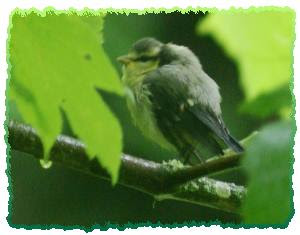
  It is pouring today and all the birds, especially the young ones are looking very bedraggled. Pete found a baby blutit by the burn this morning, dangerously close to being drowned. He picked it up and it hopped up his arm onto his shoulder and was then chrping to be fed. Pete quickly put it on a low branch, then at a distance, watched until its Mum came back and fed it.
 The pheasant, we have named him Hoppity, finds refuge and food in our garden daily and now comes when called. He looks a bit of a state as he has a limp, hence the name, and a battered tail.
 We now have both male and female Great Spotted Woodpeckers visiting the garden daily.


